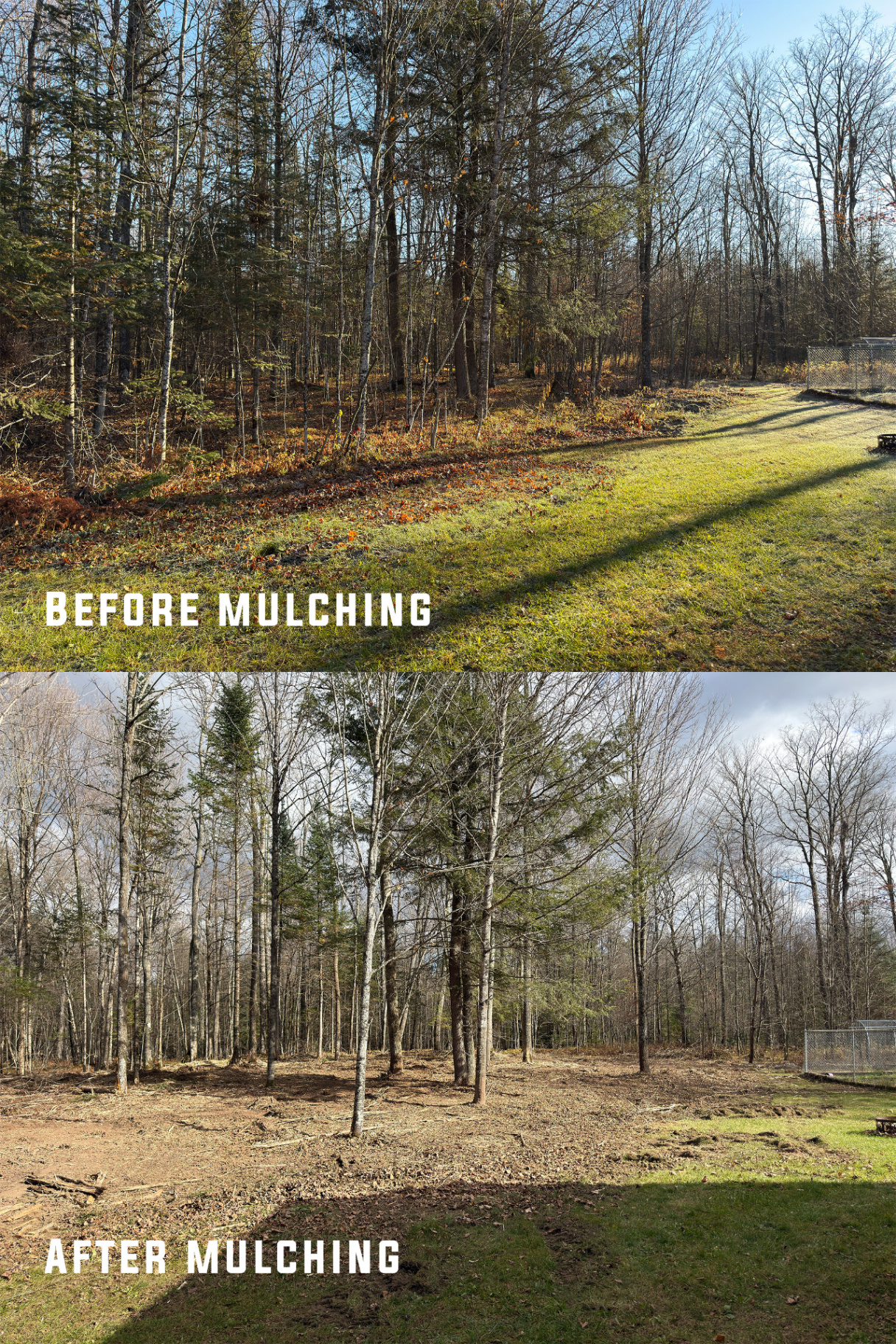
Fence line reclaimed near Crivitz, WI
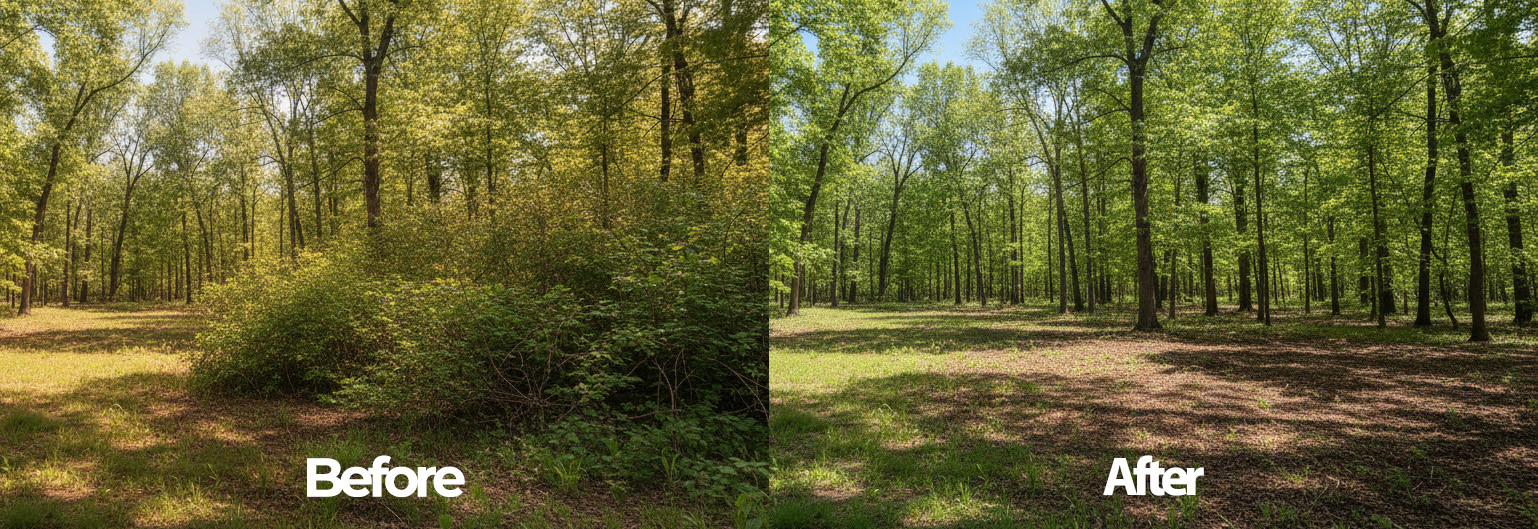
Trail reopened in Marinette County
Brush Clearing & Land Clearing in Northeast Wisconsin
If you're searching for brush clearing, woods cleanup, brush hogging, or a skid steer brush cutter service — this is what we do. We use forestry mulching to clear brush and small trees and leave a clean mulch finish. No burn piles. No hauling.
Based in Coleman, WI and serving nearby communities across Northeast Wisconsin.
Quick Navigation
Best fit for
- Overgrown lots and property edges you want usable again
- Underbrush clearing so you can walk your woods and see what you own
- Trails and access lanes (walking or ATV) through thick brush
- Shooting lane and food plot access clearing for hunting property
- Fence line and field edge clearing so brush stops swallowing your boundaries
- Clearing dense invasive thickets (buckthorn/honeysuckle/wild rose/prickly ash) when the goal is a usable reset
Not a fit for
- Full excavation/grading (pads, roads, trenches, septic installs, ponds)
- Timber harvest work where the goal is logs/firewood, not mulching
- Full stump and root removal across the entire area
- Tight residential work right next to landscaping, structures, or overhead lines
- Areas that stay saturated or have standing water where equipment would sink or get stuck
- Properties with buried wire/metal everywhere that can't be removed or clearly flagged
If you're unsure, send a few photos and a map pin. I'll tell you quickly if this is the right tool for the job — and what to do instead if it isn't.
Forestry mulching explained
Most landowners don't search "forestry mulching" — they search the outcome: brush clearing, woods cleanup, underbrush removal, or brush hogging small trees. Forestry mulching is the method: a purpose-built mulching head grinds vegetation where it stands and leaves mulch on-site. It's a clean way to reclaim overgrown areas without burn piles or hauling.
If you are not sure whether your property is a fit, send a few photos and a rough pin and I will tell you what I think.
Is this the right service for you?
Best fit
- You want an overgrown property cleaned up into a usable, park-like space
- You need access cleared for trails, hunting lanes, fence lines, or a future project
- You want brush, saplings, and small trees handled in a single pass
- You want the material mulched on-site instead of piled up for hauling or burning
- You care about keeping the ground intact and avoiding a torn-up finish
Not a fit
- Full excavation/grading (pads, roads, trenches, septic installs, ponds)
- Timber harvest where the goal is logs/firewood, not mulching
- Full stump and root removal across the entire area
- Tight residential work right next to landscaping, structures, or overhead lines
- Areas that stay saturated or have standing water where equipment would sink
- Properties with buried wire/metal everywhere that can't be removed or flagged
Next step: Send a few photos plus the address or a map pin and I'll tell you the most realistic path forward.
Is Your Property Overgrown?
Many landowners in Northeast Wisconsin have property that's grown out of control. Maybe you inherited land that hasn't been managed in decades. Maybe you bought a wooded lot that's too dense to walk through. Or maybe brush is slowly taking over your fields and fence lines.
Whatever the situation, overgrown land is frustrating. It's unusable, unattractive, and often getting worse every year as brush spreads further.
Who This Service Is For
What You Get
After we clear your property, you'll have:
- Immediate access — walk your land the day we finish
- Clean ground — mulch left on-site, no debris piles
- Visible property lines — see what you actually own
- Usable space — ready for whatever comes next
Our Brush Clearing Process
Site Details & Assessment
You tell us about your property — size, location, what's growing there, and what you want cleared. Share any concerns about access, utilities, fencing, or areas to avoid. Photos or property maps help. For larger or complex jobs, we may schedule a site visit.
Plan & Estimate
We review your property details and provide a clear estimate. This includes what we'll clear, what we'll leave, approximate timeline, and pricing. No surprises — you'll know exactly what to expect before we start.
Clearing Work
We bring our forestry mulcher (a Cat 275 XE with HM418 mulching head) and get to work. The machine cuts, grinds, and mulches vegetation in a single pass. Brush, saplings, and small trees up to roughly 4–6 inches are reduced to mulch that stays on the ground.
Finished Result
When we're done, you have cleared land with a layer of mulch on the ground. No burn piles, no debris to haul, no waiting. Walk your property the same day and start planning what's next.
What We Can (and Can't) Clear
Forestry mulching works great for brush and small trees, but it has limits. Here's what to know:
Best For:
- • Brush, saplings, and small trees (commonly around 4–6" diameter; larger depends on species and site)
- • Buckthorn, honeysuckle, prickly ash, wild rose and similar thickets
- • Overgrown fields/edges and neglected woodlots
- • Understory clearing beneath mature trees (selective clearing)
- • Trails, access lanes, and boundary visibility
Limitations:
- • Large trees require a different approach
- • Rocky sites and hidden debris slow work and increase wear risk
- • Hidden wire/metal can damage equipment (must be removed/flagged)
- • Extremely steep slopes may be inaccessible
- • If ground conditions aren't firm enough to finish clean, we reschedule or decline
Before We Arrive
- • Mark any underground utilities (call 811)
- • Flag any trees or areas you want to keep
- • Remove or flag old fencing and wire
- • Identify septic systems, wells, and tile lines
- • Let us know about any hidden hazards (old foundations, debris, etc.)
What the Finished Result Looks Like
After forestry mulching, your land will look noticeably different — but it won't look like a golf course. Here's what to expect:
Forestry mulching method
Forestry mulching is the method we use for most land clearing jobs. It is a single-pass approach that grinds brush and smaller trees on-site so you are not left with piles to burn or haul.
This page is the best place to understand what the method is, what it is best for, and what to expect on your property.
Pricing and process
How pricing works
Pricing is driven by brush density, stem size, maneuvering room, terrain, access, and hazards like wire or scrap. The fastest way to get a realistic estimate is to send 3–6 photos of the thickest areas plus an address or map pin.
If you prefer, we can walk it together and talk through options.
What to expect
You show me the goal and the boundaries, even if it is just on a map photo
I confirm what is realistic, and what results you can expect
We schedule the work window that makes sense for ground conditions and your timeline
I complete the clearing and leave the site clean and usable for the next step
Frequently Asked Questions
What does brush clearing cost?
Costs depend on density, stem size, maneuvering room, terrain, and hazards like old wire. If you want a fast number, text/email 3–6 photos of the worst spots plus a map pin and tell me the goal.
What size trees can you clear?
Forestry mulching is best for brush and smaller trees. Most jobs are in the 4–6 inch range, with occasional larger stems depending on species and site conditions. If you send photos, I'll tell you what's realistic.
What happens to the brush after clearing?
It's mulched in place. No burn piles, and no hauling by default. The mulch layer breaks down over time and protects the soil surface.
Will it grow back?
Some regrowth is normal, especially with aggressive species. The point of mulching is to reset the area so it's easy to maintain. If the site is prone to resprouting, I'll recommend a simple maintenance plan.
Do you remove stumps or roots?
Mulching grinds small stumps down close to ground level, but it does not excavate and remove entire root systems. Full root removal is a different scope.
Can you clear around trees I want to keep?
Yes. Selective clearing is one of the main advantages — we can open up understory while preserving canopy trees.
Can you clear land in winter?
Yes, when conditions allow. Frozen, firm ground can be a great window in Northeast Wisconsin. Winter windows depend on weather.
What if parts of my property stay soft or have standing water?
We avoid areas where the machine would sink or get stuck. If there are small soft spots we can work around them, we will — otherwise we reschedule for better conditions or recommend a different approach.
Areas We Serve
We provide land clearing and forestry mulching services throughout Northeast Wisconsin from our base in Coleman.